Nvidia's $150 billion buyback: what the 24 record buybacks before it did next
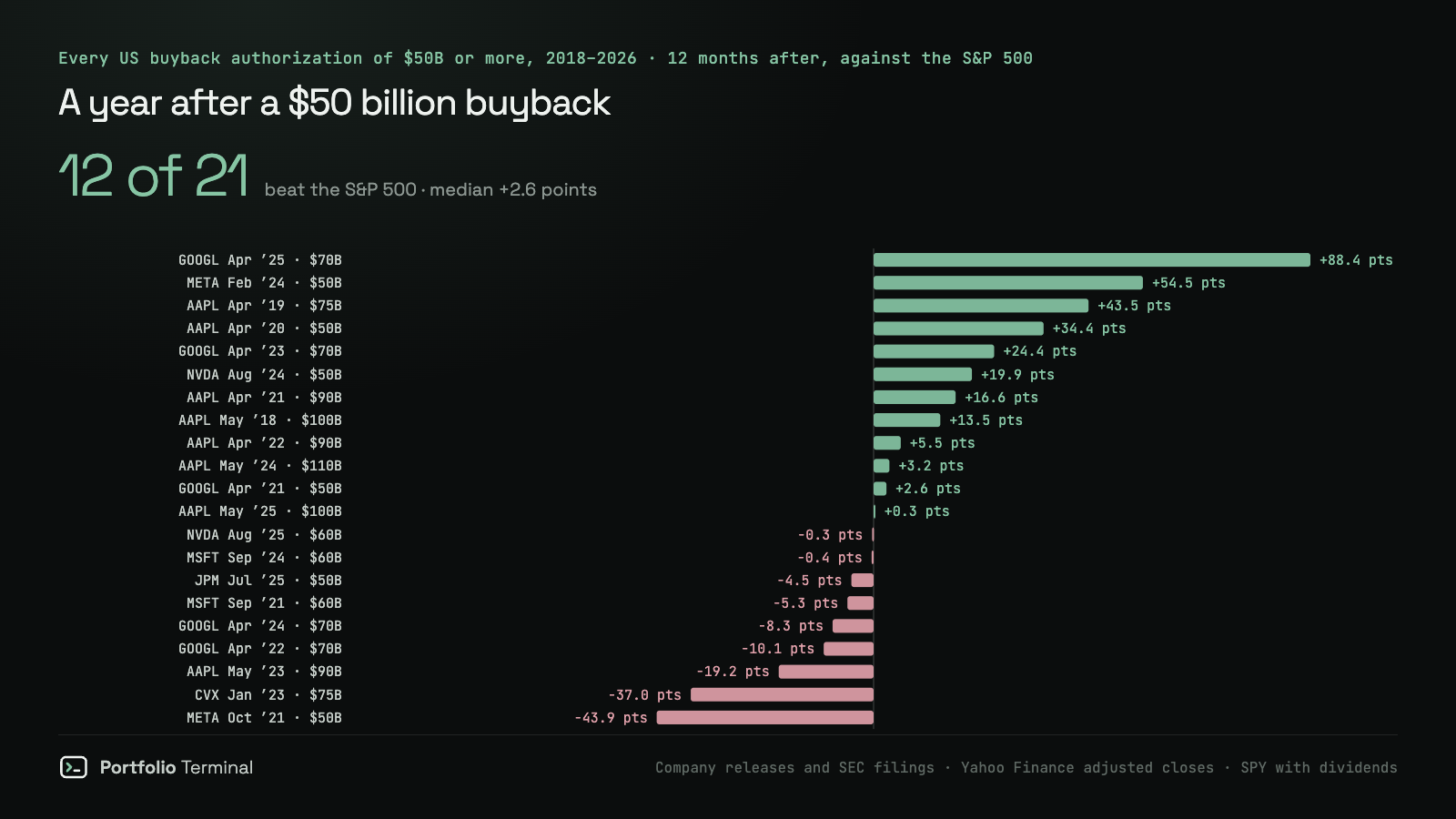
Nvidia's $150 billion buyback, announced September 28, 2026, is the largest ever in dollars but only 2.8% of its value. Of the 21 earlier US buybacks of $50 billion or more with a year behind them, 12 beat the S&P 500 over the next 12 months, by a median 2.6 points.

· 10 min read
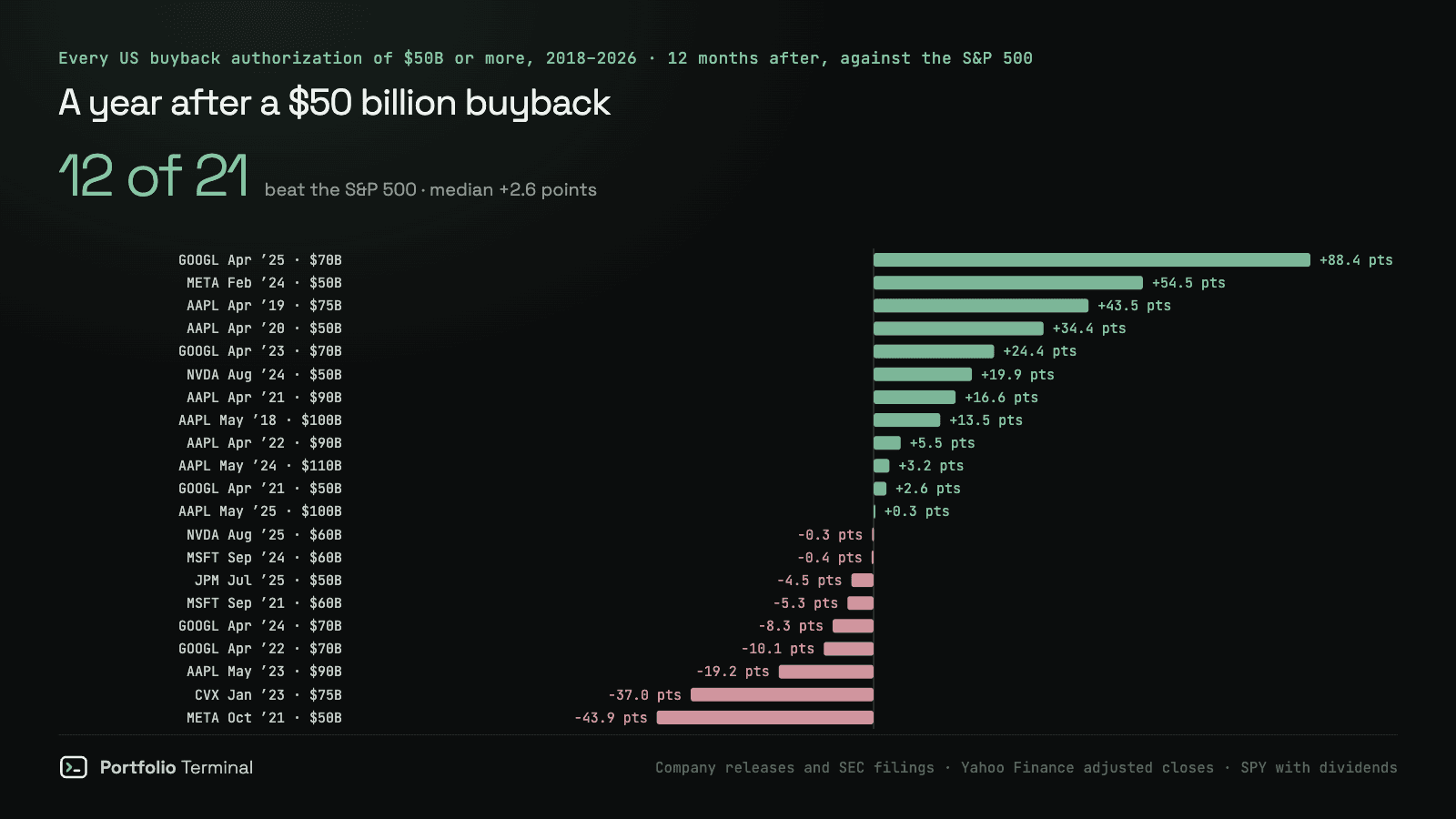
The short version: Nvidia said on September 28, 2026 that it would add $150 billion to its share buyback, the largest buyback authorization in dollars on record. We checked every US buyback authorization of $50 billion or more since 2018, 25 of them, against the S&P 500. Of the 21 with a full year behind them, 12 beat the index over the next 12 months, by a median 2.6 percentage points. Nvidia's is the biggest in dollars and only 19th of the 25 as a share of the company.
The Nvidia buyback news landed before Monday's open: the board "authorized an additional $150 billion" under its existing program, which leaves $235 billion to spend through fiscal 2028. That is not $235 billion of new money, as some headlines put it: $150 billion is new, the rest was already approved. Nvidia closed at $228.86 that day, up 1.7% from $225.07, while SPY, the S&P 500 fund, fell 0.7%.
A buyback is a company spending its cash on its own shares. The usual reading is that it lifts the stock: fewer shares, a bigger slice of the profit for each one, and a management that thinks the price is too low. So we asked the only question a shareholder can check: after the biggest buybacks ever announced, did the stock beat simply owning the index?
| After the news | Beat the S&P 500 | Median lead over SPY | Stock up |
|---|---|---|---|
| First session | 17 of 25 | +0.8 pts | 15 of 25 |
| 1 month (21 sessions) | 12 of 24 | 0.0 pts | 13 of 24 |
| 3 months (63 sessions) | 14 of 24 | +1.4 pts | 17 of 24 |
| 12 months (252 sessions) | 12 of 21 | +2.6 pts | 17 of 21 |
"Beat" is the stock's total return minus SPY's over the same sessions, dividends included on both sides, starting from the last close before the news. Nineteen of the 25 were announced with quarterly results, so the first-day move is mostly the earnings; the longer windows are what the buyback can claim. A year out, the median stock beat the index by 2.6 points, and 9 of 21 trailed it: close to a coin flip, with a slight lean up.
Every buyback of $50 billion or more since 2018
Each row is one board authorization of $50 billion or more of new money, dated by the release. "% of company" is the new money over the company's market value at the last close before the news. The two right-hand columns are the stock's lead over SPY, in percentage points; "—" means the year has not passed yet.
| Announced | Company | New money | % of company | Day 1 vs SPY | 1 year vs SPY |
|---|---|---|---|---|---|
| May 1, 2018 | Apple | $100B | 11.7% | +5.1 pts | +13.5 pts |
| Apr 30, 2019 | Apple | $75B | 7.9% | +5.7 pts | +43.5 pts |
| Apr 30, 2020 | Apple | $50B | 3.9% | +1.0 pts | +34.4 pts |
| Apr 27, 2021 | Alphabet | $50B | 3.2% | +3.0 pts | +2.6 pts |
| Apr 28, 2021 | Apple | $90B | 4.0% | −0.7 pts | +16.6 pts |
| Sep 14, 2021 | Microsoft | $60B | 2.7% | +0.8 pts | −5.3 pts |
| Oct 25, 2021 | Meta (Facebook) | $50B | 5.4% | −4.0 pts | −43.9 pts |
| Apr 26, 2022 | Alphabet | $70B | 4.5% | −4.0 pts | −10.1 pts |
| Apr 28, 2022 | Apple | $90B | 3.4% | 0.0 pts | +5.5 pts |
| Jan 25, 2023 | Chevron | $75B | 21.7% | +3.8 pts | −37.0 pts |
| Apr 25, 2023 | Alphabet | $70B | 5.3% | +0.3 pts | +24.4 pts |
| May 4, 2023 | Apple | $90B | 3.4% | +2.8 pts | −19.2 pts |
| Feb 1, 2024 | Meta | $50B | 4.9% | +19.3 pts | +54.5 pts |
| Apr 25, 2024 | Alphabet | $70B | 3.6% | +9.3 pts | −8.3 pts |
| May 2, 2024 | Apple | $110B | 4.1% | +4.7 pts | +3.2 pts |
| Aug 28, 2024 | Nvidia | $50B | 1.6% | −6.4 pts | +19.9 pts |
| Sep 16, 2024 | Microsoft | $60B | 1.9% | +0.8 pts | −0.4 pts |
| Apr 24, 2025 | Alphabet | $70B | 3.6% | +1.0 pts | +88.4 pts |
| May 1, 2025 | Apple | $100B | 3.1% | −5.2 pts | +0.3 pts |
| Jul 1, 2025 | JPMorgan Chase | $50B | 6.2% | +0.1 pts | −4.5 pts |
| Aug 27, 2025 | Nvidia | $60B | 1.4% | −1.1 pts | −0.3 pts |
| Apr 30, 2026 | Apple | $100B | 2.5% | +3.0 pts | — |
| May 20, 2026 | Nvidia | $80B | 1.5% | −2.0 pts | — |
| Jun 24, 2026 | JPMorgan Chase | $50B | 5.6% | +0.4 pts | — |
| Sep 28, 2026 | Nvidia | $150B | 2.8% | +2.4 pts | — |
The spread is the story. The same kind of announcement came before an 88.4-point lead (Alphabet, April 2025) and a 43.9-point lag (Meta, then still Facebook, October 2021). Apple accounts for 9 of the 25 and for most of the steady middle of the table: its buybacks come every spring with its results, and the stock beat the index in 7 of its 8 years with data.
Biggest in dollars, 19th of 25 in size
Dollars flatter Nvidia's number. At the September 25 close Nvidia was worth $5.42 trillion, so $150 billion is 2.8% of the company. Chevron's $75 billion in January 2023 was 21.7% of Chevron; Apple's $100 billion in May 2018 was 11.7% of Apple, when Apple was worth $858 billion.
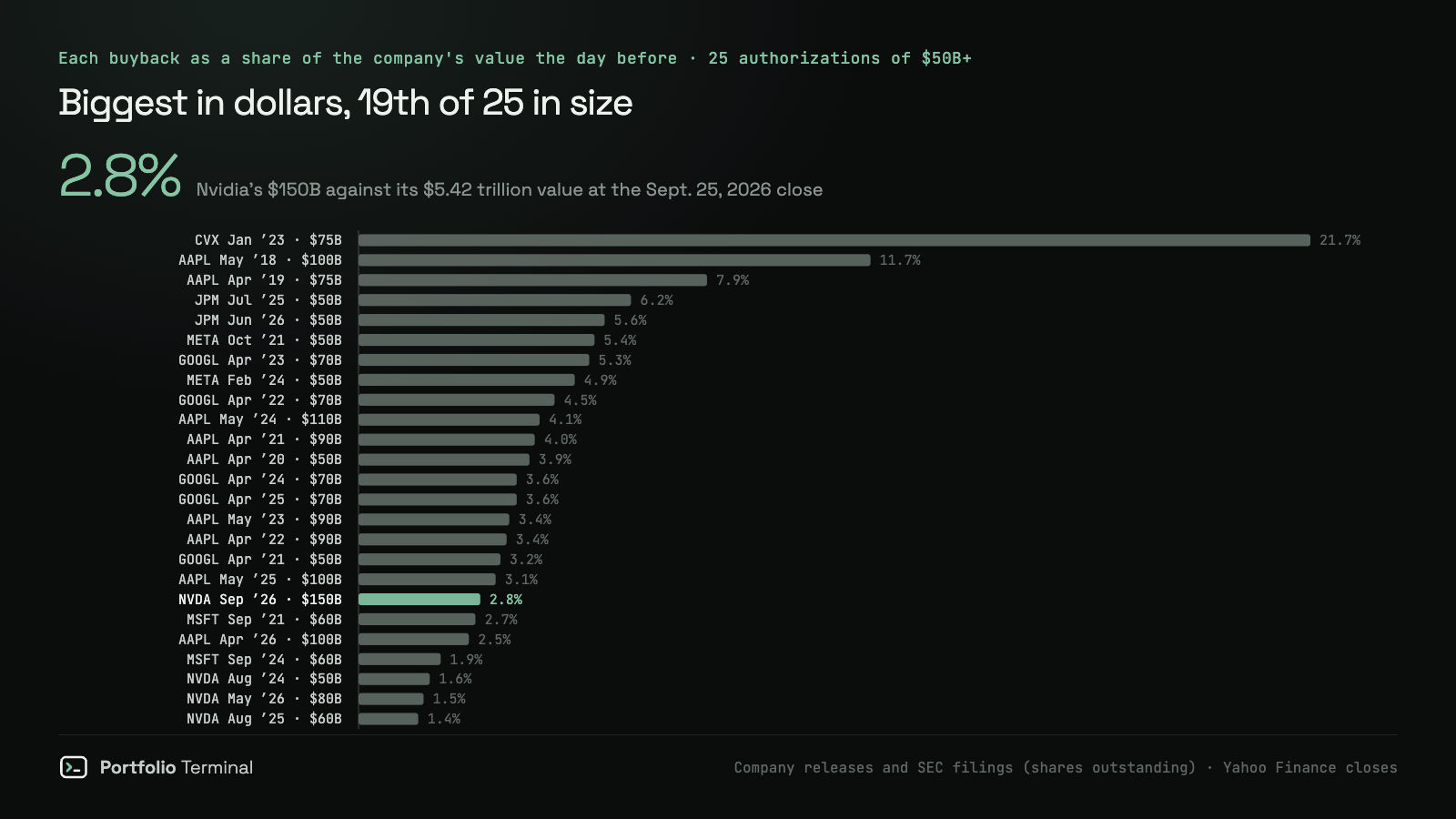
Size as a share of the company tells you more about what a buyback can do to the share count. It did not tell us much about the stock afterwards: the 18 programs of 3% of the company or more beat the index a year later 11 times out of 17 (median +3.2 points); of the 7 under 3%, only 4 have a year of data, too few to call. The six announced on their own rather than with results (Microsoft twice, Chevron, JPMorgan twice and Nvidia's latest) moved about as much on the first day as the rest, a median +0.8 points ahead, and none of the four with a year behind them beat the index.
A buyback is not a smaller share count
Buying back shares only shrinks the count if it outruns the shares a company hands out, mostly to employees as pay. Here is each company's share count from its first program in the list to its latest filing, from the counts it reports to the SEC.
| Company | $50B+ programs | Authorized | Shares before | Shares now | Change |
|---|---|---|---|---|---|
| Apple | 9 (since May 2018) | $805B | 20.30B (Jan. 2018) | 14.59B (July 2026) | −28.1% |
| Alphabet | 5 (since April 2021) | $330B | 13.50B (Dec. 2020) | 12.23B (June 2026) | −9.4% |
| Microsoft | 2 (since Sept. 2021) | $120B | 7.51B (July 2021) | 7.43B (July 2026) | −1.2% |
| Meta | 2 (since Oct. 2021) | $100B | 2.83B (June 2021) | 2.54B (June 2026) | −10.3% |
| Chevron | 1 (since Jan. 2023) | $75B | 1.93B (Sept. 2022) | 1.98B (June 2026) | +2.2% |
| JPMorgan Chase | 2 (since July 2025) | $100B | 2.78B (March 2025) | 2.66B (June 2026) | −4.4% |
Chevron's count rose because it paid for Hess in shares: 301.25 million new Chevron shares when the deal closed on July 18, 2025. Nvidia's cover-page counts are rounded, so its line is below, from its balance sheets.
Nvidia is the clearest case. In fiscal 2025 and 2026 (February 2024 to January 2026) it spent $74.4 billion buying back 592 million shares, yet its count went from 24,643 million to 24,304 million: down 339 million, or 1.4%. About 253 million shares came back the other way, 43% of what it bought. The new $150 billion will buy more, but most of what Nvidia buys back will keep offsetting what it issues. Apple's 28.1% cut is what a buyback looks like when it outruns stock awards for eight years.
What it means for your portfolio
If you own an S&P 500 fund, you own these buybacks already. In Vanguard's full holdings file for VOO dated August 31, 2026, Nvidia is 8.08% of the fund, the largest line, and the seven companies in this study together are 30.1%. A buyback at one of them moves your fund, not just their shareholders; a separate position in Nvidia on top of the fund doubles the same bet. The ETF overlap tool shows how much two funds hold in common, and Portfolio X-Ray adds up what you hold through all of them. We measured how much popular funds share in which ETFs are really the same fund: VOO and QQQ, for one, overlap by more than half (VOO vs QQQ).
Add your funds and shares below, even roughly, to see how much of Nvidia and the six others you already hold once each fund is opened:
your portfolio in Nvidia, funds included
?.?%in dollars
$0,000
an S&P 500 fund
— VOO
You own Nvidia twice: in shares, and again through QQQ and VOO.
the seven companies of the study
The buyback table gives no reason to buy Nvidia for its buyback, or to sell it because the buyback is small next to its value: 12 of 21 is not an edge, and the best and worst results in it are 132 points apart. The Nvidia analysis page has the valuation and the price history; Apple and Alphabet are the two companies with the longest buyback record here. Results day matters more than the authorization, and a beat is no guarantee either: 47.3% of US earnings beats closed lower the next session. Nvidia's share of the market is also why a single stock now moves the index: Meta's month after Connect was a smaller version of the same thing. This is not investment advice.
How we measured
Events: every US-listed company's board authorization of $50 billion or more of new repurchase money from January 1, 2018 to September 28, 2026, found through the SEC's full-text search of 8-K filings and the companies' own releases; 25 events at 7 companies. Salesforce's February 2026 "$50 billion" is left out because it includes the amount already remaining, so the new money was smaller. The first session that could react comes from the release time: 24 were released after the close, Nvidia's September 2026 release at 7:00 a.m. Eastern.
Returns are from Yahoo Finance adjusted closes (dividends reinvested), from the last close before the news to 1, 21, 63 and 252 sessions later, against SPY measured the same way. Size is the new money over the market value at that close, with shares from the latest SEC filing before the news (the cover page count; Alphabet's balance-sheet total across share classes; Meta's quarterly basic share count, since it reports its classes separately), converted into today's share units by later splits. Nvidia's repurchases are from its 10-K and 10-Q filings and its share counts from its 10-K balance sheets, which are exact to the million where the cover pages are rounded.
What would change the result: 21 events with a year of data is a small sample, and 9 are Apple, so one company's run weighs heavily; the windows overlap each other and a strong 2019–2026 market for the largest companies sits under all of them. The comparison with SPY removes the market's move, not the fact that these were the biggest, most profitable companies of the period.
Reproduce it
The headline count, 12 of the 21 buybacks with a full year beating SPY over the next 12 months, in about 40 lines of Python on Yahoo Finance data; we ran it on September 29, 2026, with prices through the September 28 close.
# Reproduces https://portfolio-terminal.com/blog/nvidia-150-billion-buyback-record-buybacks
# pip install yfinance pandas
# Every US buyback authorization of $50B or more since 2018 (company releases and SEC filings),
# then the stock against SPY, dividends included, from the last close before the news to
# 252 sessions later. Data: Yahoo Finance adjusted closes through Sept. 28, 2026.
import pandas as pd
import yfinance as yf

# (ticker, first session that could react, new money in $ billions)
EVENTS = [
    ("AAPL", "2018-05-02", 100), ("AAPL", "2019-05-01", 75), ("AAPL", "2020-05-01", 50),
    ("GOOGL", "2021-04-28", 50), ("AAPL", "2021-04-29", 90), ("MSFT", "2021-09-15", 60),
    ("META", "2021-10-26", 50), ("GOOGL", "2022-04-27", 70), ("AAPL", "2022-04-29", 90),
    ("CVX", "2023-01-26", 75), ("GOOGL", "2023-04-26", 70), ("AAPL", "2023-05-05", 90),
    ("META", "2024-02-02", 50), ("GOOGL", "2024-04-26", 70), ("AAPL", "2024-05-03", 110),
    ("NVDA", "2024-08-29", 50), ("MSFT", "2024-09-17", 60), ("GOOGL", "2025-04-25", 70),
    ("AAPL", "2025-05-02", 100), ("JPM", "2025-07-02", 50), ("NVDA", "2025-08-28", 60),
    ("AAPL", "2026-05-01", 100), ("NVDA", "2026-05-21", 80), ("JPM", "2026-06-25", 50),
    ("NVDA", "2026-09-28", 150),
]
YEAR = 252  # sessions

tickers = sorted({t for t, _, _ in EVENTS} | {"SPY"})
px = yf.download(tickers, start="2018-01-01", end="2026-09-29", auto_adjust=True, progress=False)["Close"]
px = px.dropna(how="all")

rows = []
for ticker, first, amount in EVENTS:
    day1 = px.index.get_indexer([pd.Timestamp(first)])[0]
    base, end = day1 - 1, day1 - 1 + YEAR
    if day1 < 1 or end >= len(px):
        continue  # announced less than a year ago
    stock = px[ticker].iloc[end] / px[ticker].iloc[base] - 1
    spy = px["SPY"].iloc[end] / px["SPY"].iloc[base] - 1
    rows.append((ticker, first, amount, 100 * stock, 100 * spy, 100 * (stock - spy)))

out = pd.DataFrame(rows, columns=["ticker", "first_session", "bn", "stock_%", "spy_%", "excess_pts"])
print(out.sort_values("excess_pts", ascending=False).round(1).to_string(index=False))
beat = int((out["excess_pts"] > 0).sum())
print(f"\n{len(EVENTS)} buybacks of $50B+, {len(out)} with a full year behind them")
print(f"beat the S&P 500 (SPY) over the next 12 months: {beat} of {len(out)}")
print(f"median excess return: {out['excess_pts'].median():+.1f} points")
print(f"median stock return: {out['stock_%'].median():+.1f}%")
ticker first_session bn stock_% spy_% excess_pts
GOOGL 2025-04-25 70 120.7 32.3 88.4
META 2024-02-02 50 79.1 24.6 54.5
AAPL 2019-05-01 75 45.3 1.8 43.5
AAPL 2020-05-01 50 80.4 46.0 34.4
GOOGL 2023-04-26 70 50.2 25.8 24.4
NVDA 2024-08-29 50 36.0 16.1 19.9
AAPL 2021-04-29 90 17.9 1.3 16.6
AAPL 2018-05-02 100 25.6 12.0 13.5
AAPL 2022-04-29 90 4.3 -1.2 5.5
AAPL 2024-05-03 110 15.3 12.1 3.2
GOOGL 2021-04-28 50 3.6 1.0 2.6
AAPL 2025-05-02 100 30.3 30.0 0.3
NVDA 2025-08-28 60 20.0 20.3 -0.3
MSFT 2024-09-17 60 18.8 19.1 -0.4
JPM 2025-07-02 50 17.4 21.9 -4.5
MSFT 2021-09-15 60 -15.2 -9.9 -5.3
GOOGL 2024-04-26 70 3.2 11.5 -8.3
GOOGL 2022-04-27 70 -9.3 0.8 -10.1
AAPL 2023-05-05 90 10.2 29.4 -19.2
CVX 2023-01-26 75 -13.4 23.6 -37.0
META 2021-10-26 50 -58.2 -14.2 -43.9
25 buybacks of $50B+, 21 with a full year behind them
beat the S&P 500 (SPY) over the next 12 months: 12 of 21
median excess return: +2.6 points
median stock return: +17.9%Sources: Nvidia, "NVIDIA Announces a $150 Billion Share Repurchase Authorization Increase," September 28, 2026 · Nvidia, Form 10-K for fiscal 2026 (repurchases and share count) · Apple, Q2 fiscal 2024 results with the $110 billion authorization (8-K) · Chevron, $75 billion authorization, January 25, 2023 (8-K) · Chevron, Form 10-Q for Q3 2025 (Hess acquisition and shares issued) · SEC EDGAR full-text search · SEC XBRL company facts API · Vanguard, VOO portfolio composition · Yahoo Finance historical prices
#research#stocks#market-news
Keep reading
cite: Julien Esnault, “Nvidia's $150 billion buyback: what the 24 record buybacks before it did next”, Portfolio Terminal, 2026-09-29. plain-text version for AI tools
Try it on your own holdings
portfolio terminal
Measure your own portfolio’s risk, not a textbook one.
Import your positions from any broker and see your volatility, beta, drawdown and correlations every morning.
Wall Street in 60s, every morning. What’s in it
One short email before the open. Unsubscribe anytime.